Best Live Volcano Cams Right Now — All Currently Active US Volcanoes
Live webcams of every US volcano currently above NORMAL alert level. USGS feeds, real-time data, updated whenever the alert status changes.
The US has more than 160 active volcanoes. Most are dormant, but at any given time several are at elevated alert levels — meaning USGS observatories are watching them closely for signs of eruption. Live cams point at most of them.
This is the rotating list of US volcanoes currently above NORMAL alert level, with their cams.
The current list (auto-updated)
This list refreshes whenever USGS changes alert levels. As of this writing:
🟠 Great Sitkin (Aleutian Islands, Alaska) — ORANGE / WATCH
Great Sitkin has been at ORANGE/WATCH since 2021 due to ongoing slow lava effusion at the summit. The lava dome has continued growing intermittently. AVO (Alaska Volcano Observatory) monitors with seismic and infrasound data plus webcam observations.
- Live cam: AVO Great Sitkin webcam
- What you’re watching for: steam plumes, summit glow at night during incandescence events, and clear-day views of the lava dome.
🟡 Shishaldin (Aleutian Islands, Alaska) — YELLOW / ADVISORY
Shishaldin is a perfectly conical stratovolcano on Unimak Island. It had a major eruptive episode in 2023-2024. Now at YELLOW/ADVISORY due to elevated heat output and continued unrest. Beautiful symmetric cone visible on cam during clear weather.
- Live cam: AVO Shishaldin webcam
🟡 Kilauea (Hawaii) — YELLOW / ADVISORY (Episode 46 active)
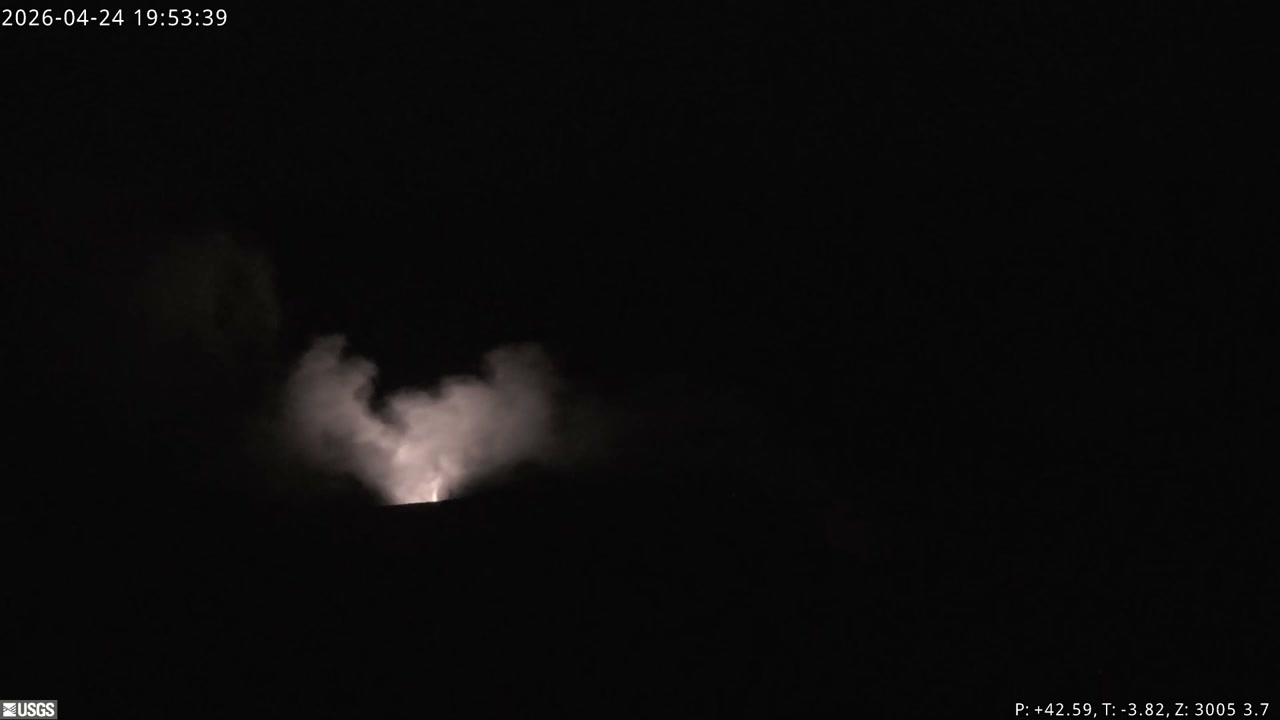
Kilauea on the Big Island of Hawaii is in active eruption mode (Episode 46 of the 2024-2026 sequence began May 5, 2026). Lava fountains have been reaching 200-400 feet during peak activity. The HVO operates 6+ cams pointed at the summit.
- Live cams (all on Port of Cams):
- V1cam — West Halemaʻumaʻu (closest to lava lake)
- V2cam — East Halemaʻumaʻu (cross-crater scale)
- V3cam — South Halemaʻumaʻu (PTZ — operators repoint to follow activity)
- Deep dive: Kilauea Episode 46 Live Coverage post
What the alert levels mean
USGS uses two parallel scales for active volcanoes:
Color codes (aviation perspective — ash hazard):
- 🟢 GREEN — Normal, non-eruptive. Background activity only.
- 🟡 YELLOW — Advisory. Elevated unrest above normal. May or may not lead to eruption.
- 🟠 ORANGE — Watch. Heightened unrest with significant eruption likely, OR ongoing minor eruption with limited ash hazard.
- 🔴 RED — Warning. Eruption forecast imminent or ongoing with significant ash emission.
Alert levels (ground-based hazard):
- NORMAL — Background.
- ADVISORY — Elevated unrest.
- WATCH — Heightened unrest, eruption possible.
- WARNING — Eruption imminent or ongoing.
The two scales are independent. A volcano can be ORANGE/WATCH if it’s erupting lava but producing no ash, or YELLOW/ADVISORY if seismic activity is elevated but no eruption is imminent.
How to watch
Volcano cams are most rewarding with the right viewing strategy:
- Pick one as your “home cam.” Watch it daily for a week. You’ll learn what “normal” looks like — steam patterns, baseline glow, weather. When something changes, you’ll see it before USGS posts an update.
- Layer cams during active eruptions. Multi-angle viewing (e.g., V1+V2+K2 for Kilauea) gives you 3D understanding no single cam provides.
- Subscribe to USGS Volcano Notice service. volcanoes.usgs.gov/hans-public/ emails you when status changes. Pair with cam viewing for full picture.
- Time-zone the cams. Alaska volcanoes (UTC-9) are on cam during US morning/lunch. Hawaii (UTC-10) is the same window. Plan viewing accordingly.
Why we keep this list
USGS publishes alerts as raw API data. Most people don’t know that’s available. We automate watching it (our event-watcher script polls every 30 minutes) and surface the currently-elevated volcanoes here with their cams already set up.
So when something changes, you don’t have to hunt — the cams are already on Port of Cams, the alerts are already posted, the context is already written.
Cams that aren’t currently elevated (but worth bookmarking)
These US volcanoes have permanent cam coverage even at NORMAL status:
- Mount St. Helens (Washington) — JRO observatory cam at portofcams.com/cameras/mt-st-helens-johnston-ridge/
- Mount Rainier (Washington) — Multiple Tatoosh/east/mountain cams
- Mauna Loa (Hawaii) — MK + MO cams
- Yellowstone caldera — Mammoth, Old Faithful, geyser-area cams (technically a supervolcano)
If any of these go elevated, they’ll appear on this list within 30 minutes.
Subscribe / follow
For every USGS alert change, we post a short update on:
- @Portofcams on X
- Port of Cams YouTube (Shorts of any active eruption)
- This blog (as updates)
Bookmark the page. The list rotates as nature does.
