Live Aurora Cams Worldwide 2026 — Alaska, Iceland, Yukon, Norway
9 live aurora cams worldwide ranked by visibility, uptime, and cloud cover — plus the forecast tools that pair with each cam.
A Kp 7 alert hit my phone at 11:48 p.m. on a Tuesday in March. I sat down at the desk, pulled four aurora cams across two monitors, and started flipping between Cleary Summit, Murmansk, Tromsø, and Iceland’s Kirkjufell cam. Within 14 minutes the curtains were visible on three of them. Within an hour the storm had pushed the auroral oval far enough south that even a Yukon cam in southern latitudes was lit. That night was a reminder that the right cam matters more than the right camera — when it’s going, you want the angle on the right side of the planet.
This is the 2026 list of the live aurora cams that actually deliver, ranked by uptime, view, and how much they’re worth refreshing during a storm.
Why the cam location matters more than camera quality
You can have the world’s best aurora camera pointed at a sky covered with clouds. It produces nothing. The variables that matter most:
- Latitude. The auroral oval normally sits between 65–75°N. The closer the cam is to that band, the more nights it produces.
- Cloud climatology. Iceland is famously aurora-rich but also famously cloudy. Interior Alaska is colder, drier, and clearer.
- Light pollution. Cams next to small towns work; cams in cities don’t.
- Uptime. Some cams go offline for weeks. Others stream year-round.
The cams below balance all four.
Alaska cams (the most reliable set)
Cleary Summit (Steese Highway, north of Fairbanks)
The reference cam. Murky-clear sky most nights. Latitude ~65°N puts it dead-center in the auroral oval. Operated by Aurora Borealis Lodge and others.
Poker Flat Research Range
University of Alaska Fairbanks scientific station. The all-sky camera at Poker Flat is genuinely scientific imagery. Free to view via PFRR’s website.
Fairbanks rooftop cams
Various University of Alaska and private cams pointed north. Useful as a backup when Cleary is fogged.
Coldfoot (above the Arctic Circle)
The Coldfoot Camp area has a couple of pointed-north cams. Higher latitude than Fairbanks but worse weather. Worth checking when you’ve got a major storm.
Yukon cams
Whitehorse area
A handful of cams operated by lodges and the city. Less reliable uptime than Alaska’s. Worth bookmarking but not your primary.
Dawson City
The historic mining town has a private cam at one of the lodges. Lower frame rate but legitimate dark sky.
Iceland cams
Kirkjufell area
Possibly the most photographed mountain in Iceland. A handful of webcams pointed at it. Aurora visibility depends entirely on cloud cover, which is unfortunately the limiting factor in Iceland 200+ nights a year.
Reykjavik live cams
Multiple city cams. Light pollution makes aurora visibility weak unless it’s a strong storm. Useful for quick “is it happening?” checks if you’re in town.
Norway cams
Tromsø
The Lofoten and Tromsø area sits at ~69°N — solidly in the oval. Cloudier than Alaska but when it’s clear, the show is incredible. The University of Tromsø operates a public sky cam.
Senja and Lofoten Islands
Several private webcams pointed at fjords. Fewer than Tromsø but the foregrounds are extraordinary.
Murmansk (Russian side)
Operates intermittently. Notable as the only Russian-side cam still publicly viewable.
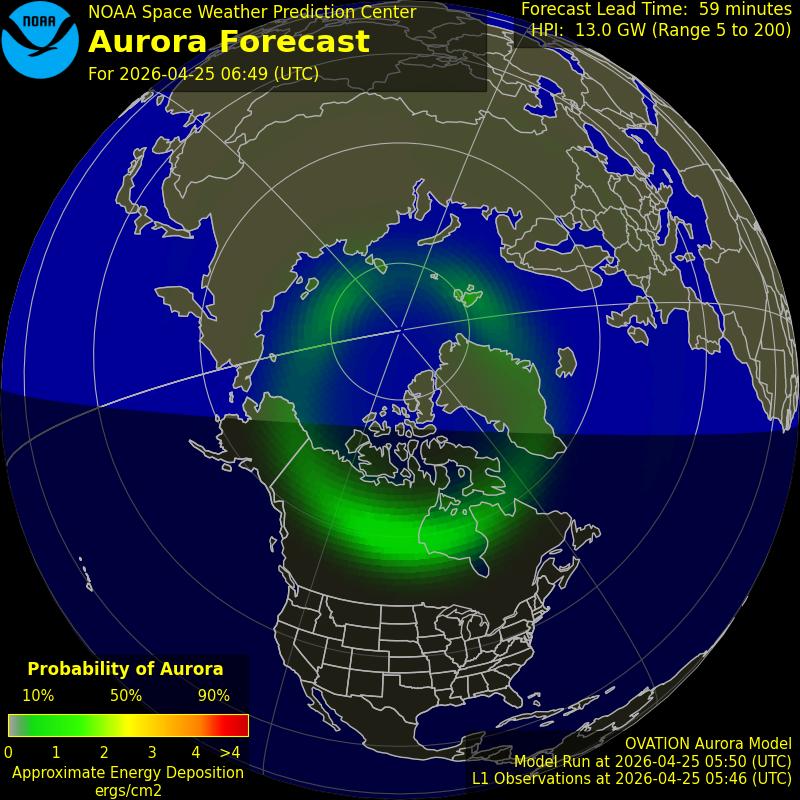 NOAA SWPC northern-hemisphere forecast, April 24, 2026. The model that powers every consumer aurora app. Bookmark the source.
Forecast tools to pair with cams
A live cam without a forecast is just a cam. With a forecast, you know when to start refreshing.
- NOAA SWPC 30-Minute Forecast — The OVATION model. Gold standard. spaceweather.gov
- My Aurora Forecast & Alerts — Mobile app. Solid push notifications.
- Glendale App — Designed for serious chasers; surfaces solar wind data and Bz orientation.
- SWPC Aurora Dashboard — Real-time Kp index, solar wind speed, particle flux.
- Clear Outside — Pair with the above for cloud cover forecasts at specific cam locations.
The combo I use: My Aurora Forecast on phone for alerts, NOAA SWPC dashboard on desktop, and Clear Outside open in another tab. When all three line up — Kp 5+, dark sky, low clouds at any of the cam sites — I sit down to watch.
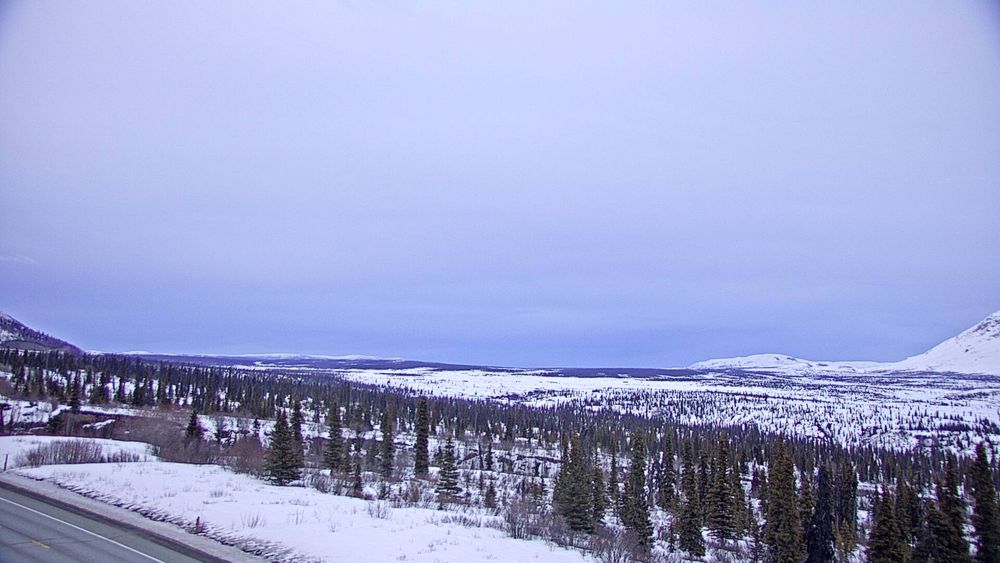 Alaska DOT cam in the Fairbanks corridor, April 24, 2026. State traffic cams are an under-discussed aurora-cam alternative — same dark sky, same time zones, free.
How to set Kp alerts
Three options, increasing in seriousness:
- My Aurora Forecast app — push notifications at thresholds you set (e.g., Kp 5, Kp 6).
- SpaceWeatherLive Premium — paid notifications.
- NOAA SWPC RSS feeds — old-school, integrate with IFTTT or n8n for custom alerts.
Personally I run an n8n workflow that pings me on Slack at Kp 5, then again at Kp 6, then a louder one at Kp 7+. I don’t get many false alarms, and during a storm I’m at the desk in 30 seconds.
The contrarian take
Alaska cams are mostly better than Iceland’s. Iceland gets the aurora reputation because it’s tourist-friendly, but the sky is clearer in interior Alaska more nights of the year. If you’re going to refresh a cam during a storm and want the highest probability of seeing something, default to Alaska first, then Norway, then Iceland.
The exception: when a storm is reaching into mid-latitudes (Kp 8+), Iceland’s lower latitude can mean the aurora is right overhead instead of on the northern horizon — and the foregrounds are dramatic.
Frequently asked questions
Best Kp threshold? Kp 4+ in Fairbanks/Cleary, Kp 5–6 in Anchorage and southern Norway, Kp 6+ in Iceland, Kp 7+ for mid-latitude visibility.
When is aurora most active? The current solar cycle (Solar Cycle 25) peaked around 2024–2025 and remains very active through 2026. Equinox months (March, September) tend to produce more frequent storms than solstice months.
Free cams? All the cams listed above are free. Some lodges run premium feeds with higher resolution.
Time zones to watch?
- Alaska cams (UTC−9): peak viewing 10 p.m.–4 a.m. AKST = 6 a.m.–noon UTC
- Iceland (UTC+0): peak viewing 9 p.m.–3 a.m. local
- Norway (UTC+1 / +2): peak viewing 10 p.m.–4 a.m. local
Phone alerts? Yes, set them up before a trip if you’re aurora-chasing. The right alert at the right time gets you out of bed in time.
See also: Northern Lights Cams, Alaska Webcams Guide, Alaska Driving Cams. Cross-link: LFE Aurora Photography Guide for camera settings.