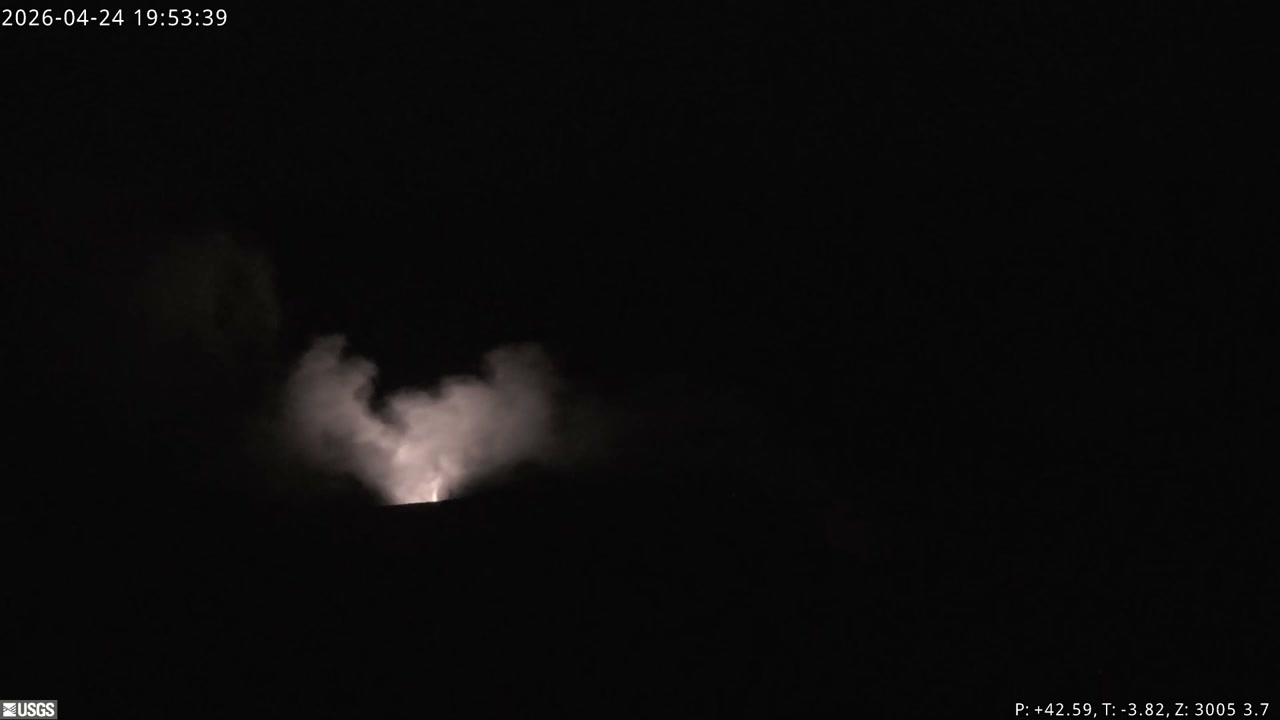
USGS Kīlauea Cams Compared — V1, V2, V3 and Which Angle Is Best
USGS streams six webcams on Kilauea's summit. Here's a cam-by-cam breakdown — V1, V2, V3, K2, B1, B2, S2, KW — and which one to pick for what you want to see.
If you’ve spent any time on the USGS Hawaiian Volcano Observatory cam pages, you’ve probably noticed the cryptic naming: V1cam, V2cam, V3cam, K2cam, B1cam, B2cam, S2cam, KWcam, MKcam, MOcam. Each one shows something different, and which one you should pick depends entirely on what you want to see.
This is the cam-by-cam breakdown — what’s in frame, what’s the strength, what’s the weakness, and when each is worth watching.
The naming convention (so it stops feeling random)
USGS cam names are basically location-coded:
- V prefix = vantage points around Halemaʻumaʻu crater (current eruption focus)
- K prefix = wider Kīlauea summit caldera views
- B prefix = down-dropped block area, eastern summit
- S prefix = south rim of Halemaʻumaʻu
- KW = Kīlauea West rim of the summit caldera
- M prefix = Mauna Loa observatory cams (different volcano)
Once you know the prefixes, the cam choices stop feeling arbitrary.
V1cam — West Halemaʻumaʻu
Direct watch: youtube.com/watch?v=HggWKlZv9yk
JPG snapshot: volcanoes.usgs.gov/observatories/hvo/cams/V1cam/images/M.jpg
V1cam is mounted on the western rim of Halemaʻumaʻu and looks across at the active vent. It’s the closest view to the lava lake and the dominant vent for the 2024-2026 eruption sequence. When fountains erupt, V1cam captures the height and detail of individual lava jets clearly.
Best for: Close-up lava lake watching, individual fountain dynamics, glow at night. Weakness: The close framing means you lose context — you can’t see the rest of the crater or the caldera surrounding it.
V2cam — East Halemaʻumaʻu
Direct watch: youtube.com/watch?v=Tz5tPqRRv1Y
JPG snapshot: volcanoes.usgs.gov/observatories/hvo/cams/V2cam/images/M.jpg
V2cam looks across the crater from the eastern rim. You see the western vent across the floor of the crater. The full crater walls frame the action.
Best for: Scale. When you want to understand how big a 600-foot fountain actually is, V2cam shows the fountain plus the crater walls plus the sky. It’s the cam most likely to capture a “wow” wide shot during peak fountains. Weakness: Detail is lost. You can see lava is happening but can’t pick out individual jets.
V3cam — South Halemaʻumaʻu
Direct watch: youtube.com/watch?v=gXKuUyKt8mc
JPG snapshot: volcanoes.usgs.gov/observatories/hvo/cams/V3cam/images/M.jpg
V3cam is unique — it’s a pan-tilt-zoom (PTZ) camera. USGS operators repoint it during active eruptions to follow whatever is most photogenic. So the view changes. Sometimes you’re zoomed in tight on a vent, sometimes you’re panned wide on the whole crater floor.
Best for: “Director’s cut” viewing. USGS knows where the action is and points the cam there. Weakness: No consistency. If you’re trying to compare today’s view to yesterday’s, V3 might be aimed somewhere completely different.
K2cam — Uekahuna Bluff (Caldera Wide, 4K)
JPG snapshot: volcanoes.usgs.gov/observatories/hvo/cams/K2cam/images/M.jpg
K2cam is mounted on Uekahuna bluff — a high vantage point on the northwest edge of the entire summit caldera. It’s a 4K camera, fixed, looking south-southeast toward Halemaʻumaʻu and the eruption.
Best for: Context. K2 shows the full caldera, the surrounding landscape, the far ridge, and Halemaʻumaʻu as a feature within the larger structure. You can see weather sweeping in, vog plumes drifting, and the geometry of the caldera floor. Weakness: Lava detail is too far away to pick out. Useful for atmosphere, not action.
B1cam — East Rim, Down-Dropped Block
JPG snapshot: volcanoes.usgs.gov/observatories/hvo/cams/B1cam/images/M.jpg
B1cam looks at the down-dropped block — a section of crater floor that subsided dramatically during the 2018 eruption. It also catches a portion of Halemaʻumaʻu beyond the block. Good for seeing the geological scarring of the previous big event.
Best for: Geology nerds. The down-dropped block tells the story of 2018. Weakness: Not the dramatic eruption view most people are looking for.
B2cam — Down-Dropped Block, Lava Lake Close-Up
JPG snapshot: volcanoes.usgs.gov/observatories/hvo/cams/B2cam/images/M.jpg
B2cam is a tight close-up looking from the same area as B1 but pointed directly into the active vent. It’s similar in framing to V1cam but from a different angle, which means during paired-camera viewing you can see the same fountain from two sides.
Best for: Pairing with V1cam for stereo viewing.
S2cam — South Side of Halemaʻumaʻu
JPG snapshot: volcanoes.usgs.gov/observatories/hvo/cams/S2cam/images/M.jpg
S2cam covers the southern crater area. It’s similar in view to V3cam but fixed (no PTZ).
Best for: When V3cam is panned away from the action, S2 gives you the south view consistently.
KWcam — West Rim of Summit Caldera
JPG snapshot: volcanoes.usgs.gov/observatories/hvo/cams/KWcam/images/M.jpg
KWcam looks down on Kīlauea’s western caldera, away from Halemaʻumaʻu. It’s an outlier — most cams point at the eruption; KWcam shows the rest of the caldera (and the road system, the visitor center area, and the broader landscape).
Best for: “What’s the rest of the park doing” awareness, weather conditions, broader Kīlauea geology.
Quick decision matrix
- You want lava close-up: V1cam (or B2cam as alternate)
- You want fountain scale: V2cam
- You want “the best shot right now”: V3cam (USGS picks for you)
- You want context / atmosphere: K2cam
- You want geology / 2018 story: B1cam
- You want consistent south view: S2cam
- You want non-eruption Kīlauea: KWcam
Or — easiest — open the Port of Cams Big Island page where V1, V2, and V3 are all embedded together. Pick by mood.
Why URLs change (and how to never lose them)
USGS rotates YouTube live stream IDs. When a stream ends or restarts, the video ID changes, and any link to the old ID becomes a 404 or “this stream has ended.”
USGS solved this by maintaining canonical short URLs that 301-redirect to whatever the current live video is:
Bookmark those instead of the YouTube watch URL. They’ll always take you to the current live stream.
The JPG snapshot URLs (the volcanoes.usgs.gov/.../M.jpg ones) are static and don’t change — those are what we use for time-lapse capture on Port of Cams since they’re guaranteed reachable as long as USGS keeps the cam infrastructure online.