Share your scenic view.
Bring your coastline, harbor or mountain view to Port of Cams.
Explore camera hosting →

Three live cameras that span how aurora works in Canada: Churchill sits under the auroral oval despite being far south, Whitehorse catches it most clear winter nights, and southern Quebec only sees it in a strong storm.
The live planetary K-index loads from NOAA in your browser.
Roughly what puts aurora in Whitehorse’s sky on a dark, clear night. Higher Kp brings it overhead and brighter.
Tonight’s verdict compares NOAA’s Kp forecast for Whitehorse’s dark hours with the Kp needed here.
A dark live-video camera with the least cloud; a snapshot camera only when no video camera here is dark. Press play to watch it here.
Ranking the cameras by darkness and cloud…
Live video first, then snapshot cameras (still images that refresh every few minutes, including science all-sky cameras). Within each group: dark now first, then least cloud. “Dark” means the sun is more than 12° below the horizon at that camera; cloud is Open-Meteo’s current model value for the spot.
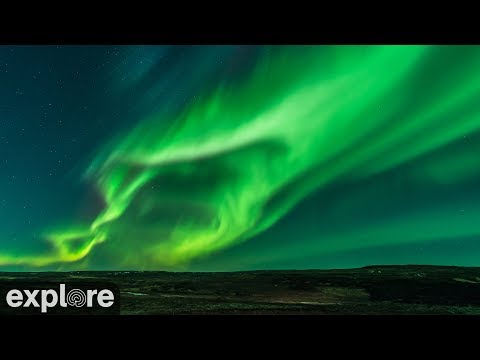 Churchill, Manitoba, Canada Churchill, Manitoba, Canada Live video Dark (sun below −12°): 7:06 PM CDT – 6:56 AM CDT
Aurora follows the magnetic pole, not the geographic one, and the magnetic pole sits on the Canadian side of the Arctic. That tilts the auroral oval south over North America: Churchill, Manitoba, at 58.7°N, is at about the same geomagnetic latitude as Tromsø at 69.6°N. Europe’s equivalent of southern Quebec is closer to southern Scotland. Roughly:
| Place | Latitude | Usually visible at |
|---|---|---|
| Yellowknife, Churchill | 58.7–62.5°N | Kp 0–2, often overhead |
| Whitehorse, Fort McMurray | 56–61°N | Kp 2–3 |
| Edmonton, Saskatoon, Winnipeg | 50–53.5°N | Kp 3–5 |
| Calgary, Vancouver | 49–51°N | Kp 5–6 |
| Toronto, Montreal, Saint-Hyacinthe | 43.6–45.6°N | Kp 6–7, low in the north |
Season: late August to mid-April in the Yukon, the Northwest Territories and Churchill. The long summer twilight in the north means no aurora from about mid-May to mid-August. Further south, aurora can happen in any month, but it takes a storm.
Time of night: local magnetic midnight in western and northern Canada is roughly 00:00–02:00 local time, later than in Europe, and displays often peak between 23:00 and 03:00. Churchill’s and Whitehorse’s cameras are in different time zones, so check the dark hours shown for each.
Forecasts: the Canadian Space Weather Forecast Centre (spaceweather.gc.ca) issues regional forecasts for the auroral, sub-auroral and polar zones, which can be more useful in Canada than the global Kp.
We have not found a live public camera in Yellowknife that stays up, so it is not in the ranking. It is still the place the rest are measured against: at 62.5°N on the shore of Great Slave Lake, the Northwest Territories capital sits almost directly under the oval, on the flat, lake-covered Canadian Shield, inland and dry. Winter high pressure brings long cold, clear spells, and the city is small enough that ten minutes’ drive puts you in the dark. Comparing the Churchill and Whitehorse cameras is the best stand-in: when both show aurora, Yellowknife, between them, almost certainly has it too.
The interior is the clear-sky side of Canada in winter. The Pacific coast and the Great Lakes are the cloudy sides, which is why Vancouver and Toronto, which would need a storm anyway, so often miss the ones that come.
In Yellowknife, the Ingraham Trail east of town and Prelude Lake, or one of the aurora lodges. Around Whitehorse, Fish Lake Road and the area around Takhini Hot Springs. In Churchill, the shore of Hudson Bay and the Churchill Northern Studies Centre’s programmes. In southern Quebec, the Mont-Mégantic International Dark Sky Reserve is the darkest place within reach of Montreal and Quebec City.
Kp: NOAA Space Weather Prediction Center. Cloud: Open-Meteo. Camera feeds belong to their operators, named on each camera page.
Sell tickets for the room. Make a plan to stream your next show beyond it.
Try another place or clear your filters.
Bring your coastline, harbor or mountain view to Port of Cams.
Explore camera hosting →Plan cameras, mixer audio and a ticketed livestream. Onsite installation or remote-assisted setup, scoped for your venue.
Plan a concert livestream →