
Skip to content
LIVE BALD EAGLE NESTS · ORDERED BY DAYLIGHT AT EACH NEST

Bald Eagle Nest Cams Live: the 2026–27 Nesting Season

A bald eagle nest cam is a whole season in one frame: sticks in the autumn, eggs in winter, chicks in spring and big young eagles flapping on the rim before they fly. These are the 7 live nest cams on Port of Cams, from Florida, where the season starts first, to Iowa, West Virginia and the Channel Islands, put in order by where it is daylight at the nest now, with what is typically happening at each stage and how to watch.

Typical for this time of year: Florida, courtship and nest building; Southern California, courtship and nest building; Iowa and West Virginia, courtship and nest building.

Streams, operators’ pages and dates checked by hand on 25 October 2026. Streams re-checked when this page was rebuilt, 27 October 2026, 19:06 UTC: 7 of 7 live.

Right now at each nest

Nests in daylight come first, then low sun; after dark, a nest with an infrared camera comes ahead of the dark ones. Cameras our health checker reports offline drop to the bottom.

  1. 1 Decorah Eagles Iowa and West Virginia CDT Best in daylight at the nest
  2. 2 Decorah North Nest Iowa and West Virginia CDT Best in daylight at the nest
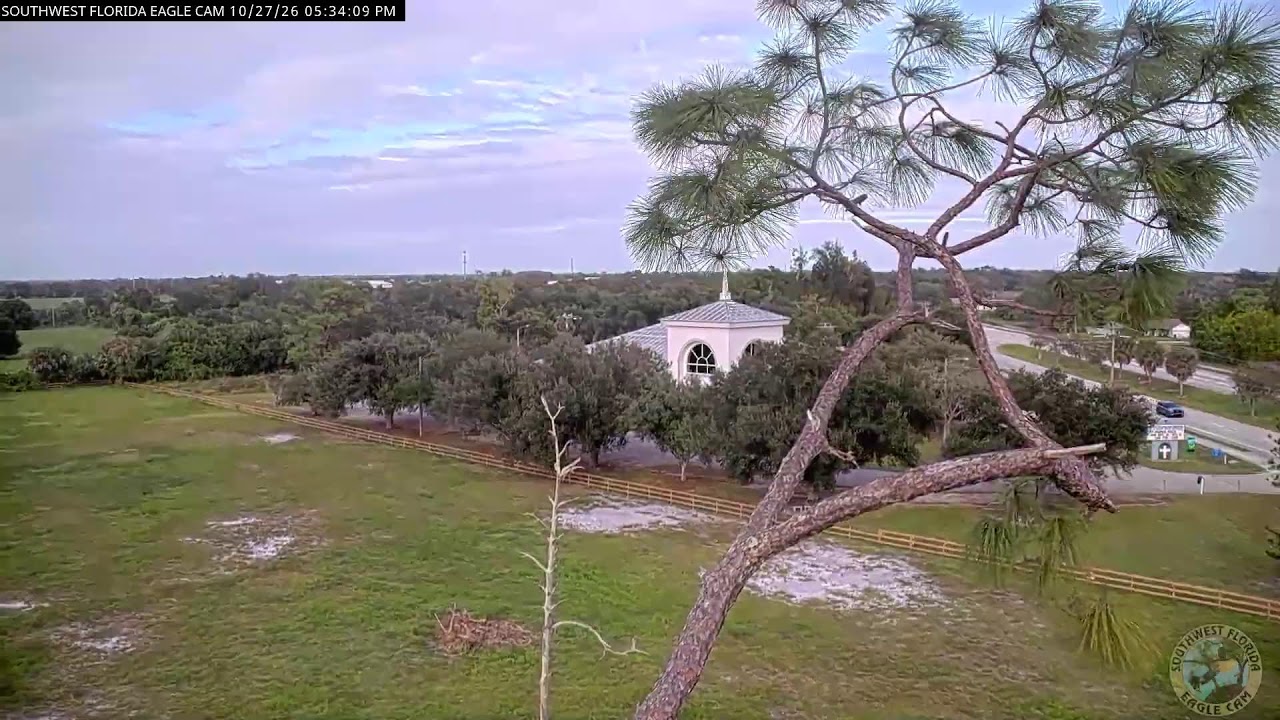
  3. 3 Southwest Florida Eagle Cam Florida EDT Best in daylight at the nest
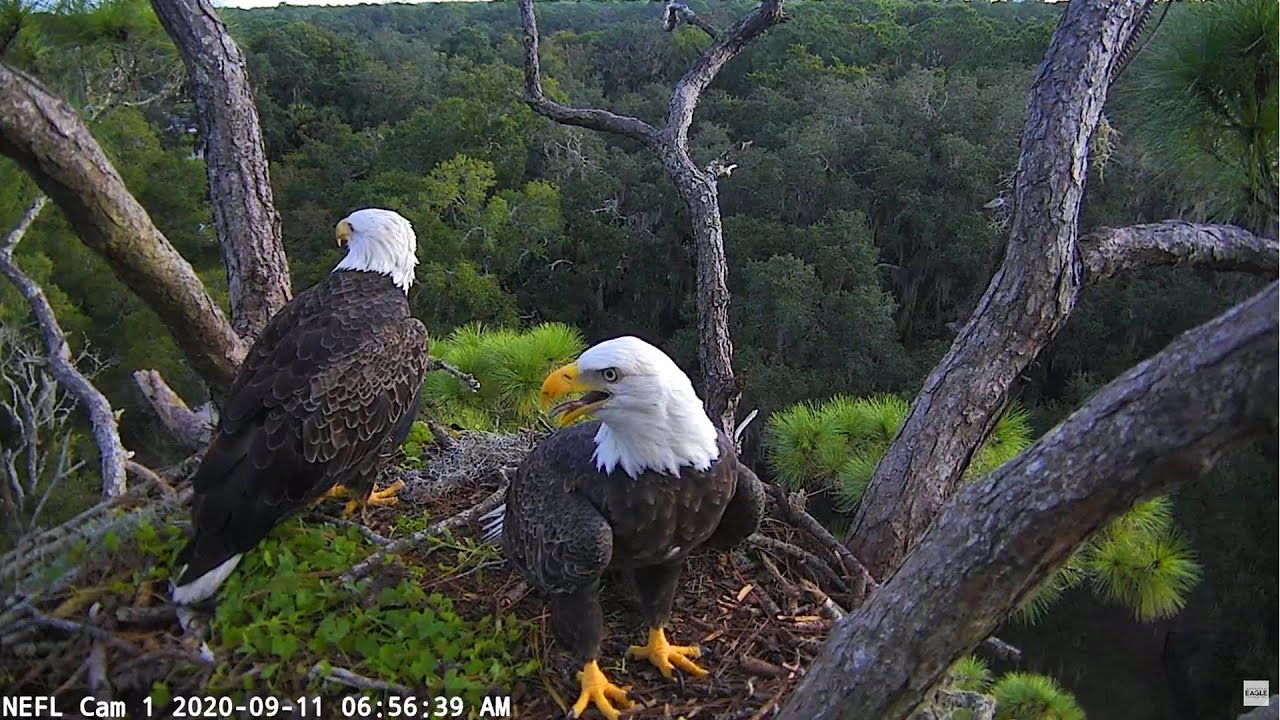
  4. 4 Northeast Florida Eagle Cam (NEFL) Florida EDT Infrared at night, so it can be watched after dark
  5. 5 NCTC Eagle Nest, Shepherdstown Iowa and West Virginia EDT Best in daylight at the nest
  6. 6 West End Nest, Catalina Island Southern California PDT Best in daylight at the nest
  7. 7 Fraser Point Nest, Santa Cruz Island Southern California PDT Best in daylight at the nest

What is happening at the nests now

Bald eagles nest at different times in different places: in hot climates such as Florida they nest in winter, and further north the eggs come in late winter. This is the typical calendar for the regions on this page, with today’s month marked. It is a pattern, not a timetable: a pair can start early, lay late, or lay a second clutch after losing the first.

  • Florida Typical now: Courtship and nest building
    1. January: Eggs and incubation
    2. February: Hatching and the nestling weeks
    3. March: Hatching and the nestling weeks
    4. April: Branching, first flights and fledglings
    5. May: Branching, first flights and fledglings
    6. June: Off-season
    7. July: Off-season
    8. August: Off-season
    9. September: Courtship and nest building
    10. October: Courtship and nest building
    11. November: Courtship and nest building
    12. December: Eggs and incubation

    Florida’s season runs from 1 October to 15 May. Building starts in late September or early October, eggs can come as early as October, and most clutches are laid between December and early January. Young fledge at about 11 weeks and disperse between April and July. Source: Florida Fish and Wildlife Conservation Commission: bald eagle biology

    Nests here: Southwest Florida Eagle Cam, Northeast Florida Eagle Cam (NEFL)

  • Southern California Typical now: Courtship and nest building
    1. January: Eggs and incubation
    2. February: Eggs and incubation
    3. March: Hatching and the nestling weeks
    4. April: Hatching and the nestling weeks
    5. May: Hatching and the nestling weeks
    6. June: Branching, first flights and fledglings
    7. July: Branching, first flights and fledglings
    8. August: Off-season
    9. September: Off-season
    10. October: Courtship and nest building
    11. November: Courtship and nest building
    12. December: Courtship and nest building

    At Big Bear, Jackie laid in late January in 2025, with chicks hatching in early March and fledging in early June; on Catalina the West End pair laid on 30 January 2024 and their chicks flew in early June. Friends of Big Bear Valley counts the season from 1 September. Source: Friends of Big Bear Valley: Big Bear eagle history

    Nests here: West End Nest, Catalina Island, Fraser Point Nest, Santa Cruz Island; Big Bear (linked below)

  • Iowa and West Virginia Typical now: Courtship and nest building
    1. January: Courtship and nest building
    2. February: Eggs and incubation
    3. March: Eggs and incubation
    4. April: Hatching and the nestling weeks
    5. May: Hatching and the nestling weeks
    6. June: Branching, first flights and fledglings
    7. July: Branching, first flights and fledglings
    8. August: Off-season
    9. September: Off-season
    10. October: Courtship and nest building
    11. November: Courtship and nest building
    12. December: Courtship and nest building

    At Decorah the pair court from October, the female lays in mid-to-late February, the eggs hatch in late March or early April and the young fledge in mid-to-late June, dispersing between August and October. The NCTC pair laid on 18 and 21 February 2026. Source: explore.org: Decorah Eagles

    Nests here: Decorah Eagles, Decorah North Nest, NCTC Eagle Nest, Shepherdstown

Courtship and nest buildingEggs and incubationHatching and the nestling weeksBranching, first flights and fledglingsOff-season

The nests, and who runs each camera

Every stream here is the operator’s own, played from YouTube. The facts about each pair come from the operator’s own page, linked on each card.

Decorah Eagles

Decorah, Iowa, beside a trout hatchery

Live videoexplore.org with the Raptor Resource Project

One of the longest-running eagle cams. After two of the pair’s nests were destroyed, the Raptor Resource Project built a starter nest here, and the eagles took it over and have built on it every year since.

The pair: Mom has nested on this territory since 2007. Her first mate, Dad, disappeared in April 2018, and the current male, DM2, joined her in October 2018. explore.org says the adults stay in the area year-round.

Typical stage now: courtship and nest building

Source: explore.org: Decorah Eagles

Decorah North Nest

Decorah, Iowa: a separate territory from the main Decorah nest

Live videoexplore.org with the Raptor Resource Project

A second Decorah territory, filmed in 4K from close to a massive nest. It runs on the same northern calendar as the main Decorah cam, so the two are a good pair to compare through the spring.

Typical stage now: courtship and nest building

Source: explore.org: Decorah Eagles
Southwest Florida Eagle Cam

Bayshore Road, North Fort Myers, Florida

Live videoSouthwest Florida Eagle Cam (Dick Pritchett Real Estate)

A pan-tilt-zoom camera on what its operator calls one of the most closely watched eagle nests in the world; the same channel also streams nest close-ups and a pond camera. Florida’s season starts months before the northern nests, so this is where the 2026–27 season gets going first.

The pair: Last season the camera followed M15 and F23, who incubated two eggs; their eaglet E26 hatched in mid-December 2025, according to the operator’s own videos.

Typical stage now: courtship and nest building

Source: Southwest Florida Eagle Cam on YouTube

Northeast Florida Eagle Cam (NEFL)

Near the northeast coast of Florida; the foundation keeps the exact site private

Live videoAmerican Eagle FoundationInfrared at night

Run by the American Eagle Foundation, a non-profit, with volunteers who keep a public event log of the season. An infrared light comes on at night, so this is the nest to watch after dark: the picture turns black and white, and the eagles cannot see the light.

The pair: The nest belongs to Gabrielle (Gabby) and Beau. After the 2025–26 season the nest went quiet when Beau left on 17 May.

Typical stage now: courtship and nest building

Source: American Eagle Foundation: NEFL Eagle Cam

NCTC Eagle Nest, Shepherdstown

National Conservation Training Center, near Shepherdstown, West Virginia

Live videoU.S. Fish & Wildlife Service

Camera 3 of the federal wildlife agency’s own eagle cam, looking down into the bowl from 10 feet above it. The pair add sticks through the autumn and winter and, the agency says, are most active in the morning, often bringing in sticks and dry grass.

The pair: A windstorm brought down the pair’s 22-year-old nest on 19 April 2025, and its three eaglets died. The adults survived and rebuilt about 15 feet lower in the same sycamore, 75 feet up, where the female laid on 18 and 21 February 2026.

Typical stage now: courtship and nest building

Source: U.S. Fish & Wildlife Service: NCTC Eagle Nest, Camera 3

West End Nest, Catalina Island

West End of Santa Catalina Island, California

Live videoexplore.org with the Institute for Wildlife Studies

A medium view of a cliffside nest on Catalina, with the perches around it in frame. The nest is part of the Institute for Wildlife Studies’ program to bring bald eagles back to the Channel Islands, which began in 1980.

The pair: A new pair holds the territory: the male, banded 29/D and called Lee, hatched on Catalina at Seal Rocks in 2022; his unbanded mate is known as Isla. Her first egg, on 15 March 2026, was taken by ravens, and the pair did not try again that season.

Typical stage now: courtship and nest building

Source: Institute for Wildlife Studies: West End nest history

Fraser Point Nest, Santa Cruz Island

The Nature Conservancy’s land on Santa Cruz Island, Channel Islands, California

Live videoexplore.org with the Institute for Wildlife Studies

A camera beside the newer of the Fraser Point pair’s two nests: they moved here from their historic nest. The stream is a joint effort of explore.org, the Institute for Wildlife Studies, The Nature Conservancy, UC Santa Barbara and the National Park Service.

Typical stage now: courtship and nest building

Source: Institute for Wildlife Studies: Fraser Point nest history

Famous nests to watch on their own channels

Two well-known nests we link to rather than play here, and why.

  • Big Bear Valley, California (Jackie and Shadow’s nest)

    The most famous nest of recent years, 145 feet up a Jeffrey pine in the San Bernardino Mountains. The stream is live, but Friends of Big Bear Valley asks for prior approval for any public use of its video, so we link to it rather than play it here. Jackie, the first eagle ever hatched in Big Bear, died on 10 August 2026 after being rescued, weak and anemic, in July. Shadow is still on the territory, and a banded young eagle from the Prado Basin, KD1 (nicknamed Kaydee and likely a female), has been checking out the nest.

    Watch on Friends of Big Bear Valley’s YouTube channel · Friends of Big Bear Valley: Big Bear eagle history

  • Dulles Greenway, Virginia

    A 4K camera and a pan-tilt-zoom camera on a bald eagle nest in Virginia. The channel restarts its streams under new video IDs, so a fixed embed here would break; open its live tab instead.

    Watch on Dulles Greenway Eagle Cam’s YouTube channel

We also looked for the Berry College eagles in Georgia and the Pennsylvania Game Commission’s Hanover nest, and found no live YouTube stream from either operator on 25 October 2026.

The nesting season, step by step

The numbers below are from the U.S. Fish & Wildlife Service and Florida’s wildlife commission (FWC), with the nests on this page as examples.

  1. Courtship and nest building

    Weeks to months before the eggs. Pairs often use and enlarge the same nest each year; a typical nest is 4 to 5 feet wide and 2 to 4 feet deep, and old ones reach 10 feet across. In Florida building starts in late September or early October; the Decorah pair court from October.

  2. Egg laying

    One to three eggs, once a year; the average clutch is just under two (1.87, says FWC). At the nests on this page the eggs came about three days apart: 18 and 21 February 2026 at NCTC, 24 and 27 February 2026 at Big Bear.

  3. Incubation: about 35 days

    Both agencies give about 35 days from laying to hatching. The adults take turns on the eggs.

  4. Hatching and the nestling weeks: about 11 weeks

    FWC puts first flight at around 11 weeks of age, and the Fish & Wildlife Service says young eagles are flying within three months. Big Bear’s two eaglets in 2025 flew at 90 and 91 days.

  5. Fledging and dispersal

    Fledglings stay with their parents near the nest for another 4 to 11 weeks in Florida (FWC); the Fish & Wildlife Service says they disperse on their own after about six weeks. In Florida, initial dispersal happens between April and July.

Sources: U.S. Fish & Wildlife Service: bald eagle · Florida Fish and Wildlife Conservation Commission: bald eagle biology · explore.org: Decorah Eagles · Friends of Big Bear Valley: Big Bear eagle history

What you’ll see at each stage

Courtship and nest buildingTypical now: Florida, Southern California, Iowa and West VirginiaThe pair bring in sticks, rearrange them and line the bowl with grass and softer material, often working on the same nest they used last year, which can grow to 10 feet across over the years. Expect visits rather than constant company: an adult landing with a stick, both birds side by side on a branch, calls back and forth.
Eggs and incubationThe nest is almost never empty. One adult lies low in the bowl over the eggs while the other hunts or perches nearby, and they swap places through the day. Most of what you see is a bird sitting very still; the moments to watch for are the shift changes, when the eggs are briefly uncovered.
Hatching and the nestling weeksThe busiest stage to watch. The adults bring fish and other prey and tear off small pieces for the chicks, several times a day. Grey down gives way to dark feathers within weeks, and by the end the young are nearly the size of their parents and feed themselves from what is dropped on the nest.
Branching, first flights and fledglingsBig young eagles flap, hop and climb onto the branches around the nest before the first real flight. After fledging they often come back to the nest to be fed and to roost, so the camera still sees them for some weeks before they leave the area.
Off-seasonThe young have dispersed and the nest is quiet. Some adults stay near the territory all year and drop in now and then, others are away; a stream can show an empty nest for days at a time. Nest building picks up again in the autumn.

How to watch

  • Turn the sound on. Our players start muted. Eagles call to each other a lot around the nest, and the sound often tells you a mate is arriving before it lands in frame.
  • Watch in daylight at the nest. The list at the top uses each nest’s own time. The Florida and West Virginia nests are on Eastern time, Decorah on Central, and the Channel Islands on Pacific, three hours behind the East Coast.
  • After dark, pick an infrared camera. Of the nests here, only the American Eagle Foundation’s NEFL cam says it switches on infrared at night.
  • Use the chat and the operators’ logs. The live chat on YouTube, where the operator runs one, and the operators’ own recaps (Friends of Big Bear Valley’s recap report, the NEFL event log) are where volunteers post which bird is which and what happened overnight. Some chats only open in season or in set hours.
  • Missed the moment? Operators post highlight clips of hatches, feedings and first flights on their channels. Where a stream has rewind switched on, drag the progress bar back, or open it on YouTube.

Etiquette

  • These are wild birds. Nobody steps in when a storm, a predator or a sibling makes things hard; eggs fail and chicks die on live camera. The operators’ chat rules ask viewers to be kind about it and to keep the talk on the eagles.
  • Don’t go looking for the nest. Some operators, like the American Eagle Foundation, keep the location private for the birds’ sake. Watching from home is the point.
  • Ask before you share video. Friends of Big Bear Valley, for one, asks for prior approval and credit for any public use of its video or screen captures, and does not allow re-streaming.

Questions

When do bald eagles lay eggs?

It depends on where the nest is. In Florida, eggs can appear as early as October, and most are laid between December and early January (Florida FWC). In southern California the nests on this page usually lay in late January or February, and in Iowa the Decorah pair lay in mid-to-late February. A pair that loses its first clutch early can lay again, as Jackie did at Big Bear in 2026.

How long do bald eagle eggs take to hatch?

About 35 days, according to both the U.S. Fish & Wildlife Service and Florida FWC. Eggs are laid a few days apart (about three days at the nests on this page), so the chicks usually hatch a few days apart too.

How long do eaglets stay in the nest?

About 11 weeks before the first flight, by Florida FWC’s figure; the U.S. Fish & Wildlife Service says young eagles are flying within three months. At Big Bear in 2025 the two eaglets flew at 90 and 91 days old. After fledging they stay near the nest for several more weeks before dispersing.

Why is the eagle nest cam empty?

Usually because of the season. Between fledging and the next autumn the young have gone and the adults only visit, and even in the building months the pair are away hunting much of the day. During incubation the nest is almost never left: an empty bowl with eggs in it is unusual and worth watching.

Can you see bald eagles at night on a nest cam?

Only on a camera with infrared or night lighting. Of the nests on this page, the American Eagle Foundation says its Northeast Florida cam turns on an infrared light at night, which gives a black-and-white picture the eagles cannot see. On the others the nest goes dark after sunset, so this page puts nests in daylight first.

What happened to Jackie at Big Bear?

Friends of Big Bear Valley says Jackie was rescued by wildlife experts on 18 July 2026, too weak to fly, underweight and anemic, and died on 10 August at the Ojai Raptor Center. Her mate Shadow is still on the territory. The Big Bear stream is live on the group’s own YouTube channel, linked on this page.

Do bald eagles use the same nest every year?

Often. The U.S. Fish & Wildlife Service says pairs often use and enlarge the same nest each year; a typical nest is 4 to 5 feet wide and some reach 10 feet across. Bald eagles mate for life, but if one bird dies the survivor will accept a new mate, which is what several of the nests on this page have seen.

Camera feeds belong to their operators (explore.org and the Raptor Resource Project, the Southwest Florida Eagle Cam, the American Eagle Foundation, the U.S. Fish & Wildlife Service and the Institute for Wildlife Studies), named on each camera page. Local times and daylight are computed in your browser from each nest’s coordinates; nothing is sent anywhere. Where an operator keeps a nest’s location private, the coordinates are a point in the region, not the nest.

CAMERA PREVIEW

Open the camera to watch its live feed.

Watch on Port of Cams ↗