No matching pages. Try a place, activity, or tool name.
HUMPBACK WHALES · NOVEMBER TO APRIL · LIVE FROM MAUI
Maui Whale Season Live Cams: Humpback Whales, November–April
Every winter roughly half of the North Pacific’s humpback whales come to Hawaiʻi to mate, give birth and nurse their calves, and the shallow channels between Maui, Lānaʻi, Molokaʻi and Kahoʻolawe are among the waters they favour. These are the live cameras on Port of Cams that look out over those channels from Maui’s west and south shores, with what to look for in each frame, when the light is best, and where to watch from the shore yourself.
Tuesday, October 27 at 9:09 AM HST
Early season: the first whales are arriving
The first humpbacks reach Maui in autumn: NOAA says they are generally seen from November, and afarTV’s West Maui camera caught a breach on 22 October 2026. Sightings are few; every blow is worth a second look.
Mornings, Hawaiʻi time, are the best light: most of these cameras face west, with the sun behind them until midday.
Next Great Whale Count: Saturday 30 January 2027.
Cameras, frames and facts checked by hand on 25 October 2026; season dates from NOAA’s humpback whale sanctuary. Streams re-checked when this page was rebuilt: 4 of 4 live; 2 not checkable then.
When the page loads, the player starts the best whale view in daylight, muted. Watch it full screen and scan the open water.
Right now at each camera
Every camera here is on Maui, so they share one clock; the list puts the open-water views first in daylight, and cameras our health checker reports offline drop to the bottom.
1Honokōwai, West Maui: the sanctuary camWest over the channel, rotating from Kahana to Molokaʻi and LānaʻiHSTMornings, Hawaiʻi time: the camera faces west, so the sun is behind it until midday and the water is easiest to read.
2Fairmont Kea Lani, WaileaWest, over Polo Beach to open oceanHSTMornings, before the sun moves round into the west and puts glare on the water.
3Wailea Beach, looking to West MauiNorth-west, across Māʻalaea Bay to the West Maui MountainsHSTMorning to early afternoon; late in the day the sun sits low in front of the camera.
4Kīhei: Hale Pau HanaNorth-west along the Kīhei shore, with open water to the westHSTMornings. The sanctuary’s own visitor center is just up the road in Kīhei.
5Kāʻanapali: Sheraton MauiSouth along Kāʻanapali Beach, with the channel on the rightHSTMornings; by late afternoon the sun is low over the open water.
6Maui Sea Shell CamOut over a reef and lawn to the channel and a neighbouring islandHSTDaylight, Hawaiʻi time.
The cameras, and where to look in each frame
Shore cameras see whales small and far away: a blow, a splash, a breach on the horizon. Each card says how much of its frame is open water.
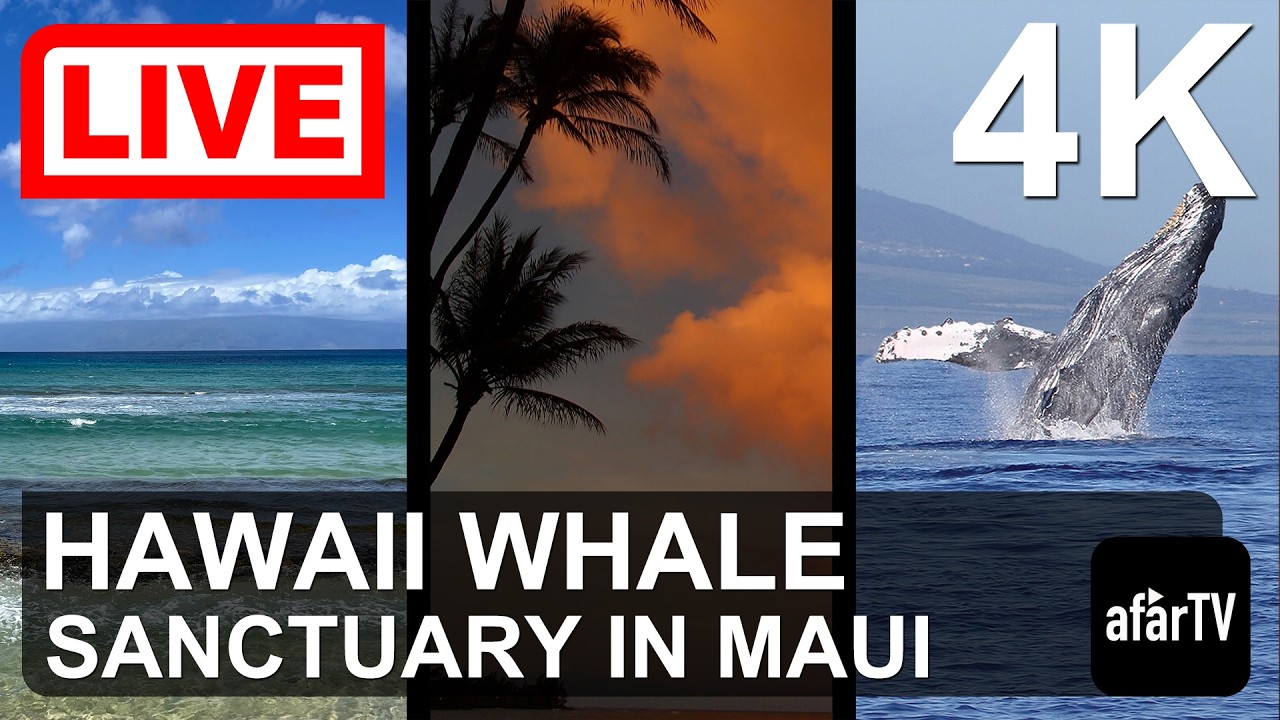
A 4K camera on the ground-floor lanai of a Honokōwai condo, looking straight out to sea. The view swings slowly from the north (Kahana) through Molokaʻi in the west to Lānaʻi in the south, and is nearly all open water and sky: the best whale view on this page.
Faces: West over the channel, rotating from Kahana to Molokaʻi and Lānaʻi
What to look for: Blows on the horizon first, then breaches. afarTV caught its first breach of the 2026–27 season here at 8:34 a.m. on 22 October 2026. The sound is a pre-recorded track from the same spot, not live audio.
When: Mornings, Hawaiʻi time: the camera faces west, so the sun is behind it until midday and the water is easiest to read.
The resort’s camera looks down over its lawns and Polo Beach, and two-thirds of the frame is open ocean running to the horizon: a big, plain blue background where a white blow stands out.
Faces: West, over Polo Beach to open ocean
What to look for: Scan the middle and top of the frame for a puff of white that hangs for a second or two. Polo Beach is one of Pacific Whale Foundation’s Great Whale Count sites.
When: Mornings, before the sun moves round into the west and puts glare on the water.
From high on the resort, a wide view over palms and a rocky point to the bay beyond, with the West Maui Mountains across the water. About half the frame is open water.
Faces: North-west, across Māʻalaea Bay to the West Maui Mountains
What to look for: Blows and splashes far out in the bay, between the point and the mountains. A breach at that distance is a small white burst; watch the full-screen player.
When: Morning to early afternoon; late in the day the sun sits low in front of the camera.
A wide-angle camera on the condo’s roof, looking along a rocky shore and lawn towards Kīhei’s beaches, with the channel opening out to the right of the frame.
Faces: North-west along the Kīhei shore, with open water to the west
What to look for: The open water on the right of the frame; whales, when they show, are well offshore.
When: Mornings. The sanctuary’s own visitor center is just up the road in Kīhei.
A view down the length of Kāʻanapali Beach from above Black Rock, with the hotels on the left and the channel towards Lānaʻi on the right of the frame. Mostly beach; the open water is a strip along the right and the horizon.
Faces: South along Kāʻanapali Beach, with the channel on the right
What to look for: The horizon on the right: blows and breaches out towards Lānaʻi. This is the busiest beach view on the page, so expect swimmers and paddlers closer in.
When: Mornings; by late afternoon the sun is low over the open water.
A Maui shoreline (the owner does not publish the exact spot)
Provider playerNest public camera
A Nest camera above a lawn and a shallow reef, looking out to open water and the outline of a neighbouring island on the horizon. Plays in Nest’s own player on its camera page.
Faces: Out over a reef and lawn to the channel and a neighbouring island
What to look for: The band of open water between the reef break and the horizon.
When: Daylight, Hawaiʻi time.
The season, month by month
NOAA’s Hawaiian Islands Humpback Whale National Marine Sanctuary says humpbacks are generally seen in Hawaiʻi from November through April, with the peak from January through March. The numbers are from the 2026 shore counts, when volunteers on every main island counted at the same hours on the last Saturday of each month; they are sightings, so the same whale can be counted twice. The current month is highlighted.
October–NovemberEarly season
The first humpbacks arrive. NOAA puts the start of the season in November; whales can turn up earlier (afarTV’s Honokōwai camera filmed a breach on 22 October 2026).
DecemberIn season
Numbers build through the month.
JanuaryPeak season
Peak season begins. The January 2026 count logged 1,954 sightings across the islands.
FebruaryPeak season
Still peak: 1,935 sightings at the February 2026 count.
MarchPeak season
The last month of the peak. The March 2026 count logged 436, as whales began heading north (and storms cut visibility).
April–MayLate season
Late season: NOAA’s season runs to April, and its boating guidance through May.
June–SeptemberOff season
The whales are at their summer feeding grounds, mostly off Alaska.
The Hawaiian Islands are the main winter breeding ground of the North Pacific humpback population. While they are here the whales compete for mates, mate, give birth and nurse newborn calves, and they keep to shallow water, less than about 600 feet deep. The sanctuary was created to protect them in those waters, and NOAA lists the Maui Nui region, the channels between Maui, Lānaʻi, Molokaʻi and Kahoʻolawe, among them, beside Penguin Bank, Oʻahu, Kauaʻi and Niʻihau, and Hawaiʻi Island.
Two of those channels are in view from the cameras here. West Maui’s shore looks across the ʻAuʻau Channel to Lānaʻi and north towards Molokaʻi, which is what the Honokōwai camera sweeps across. South Maui’s Wailea and Kīhei look out over Māʻalaea Bay and the water towards Kahoʻolawe, the view from the Fairmont Kea Lani, Wailea Beach and Kīhei cameras.
What a camera can and cannot show you
Blows. The first and most common sign: a puff of white spray above the surface that hangs for a second or two, often two or three in a row as a whale surfaces to breathe. On a calm morning they stand out against blue water even at a distance.
Breaches. A whale throwing most of its body clear of the water and crashing back. From shore it is a sudden white burst, often repeated; it is what most viewers hope to catch, and it comes without warning.
Tail and flipper slaps. Repeated splashes in one spot, where a whale is slapping the water with its tail or a long pectoral fin.
What you will not see. Close-ups. These are shore cameras looking out over miles of water, so a whale is a few pixels at most; there is no underwater camera here. Whitecaps on a windy afternoon look a lot like blows, so look for a puff that rises and hangs rather than a break that rolls.
Best time of day to watch
Morning, Hawaiʻi time. Most of these cameras face west, out over the channels, so before midday the sun is behind them and the water is easy to read. In the late afternoon the sun drops in front of them and the glare on the water hides blows; after sunset the cameras show nothing useful until morning. Hawaiʻi has no daylight saving time: it is two hours behind the US West Coast in winter and five behind New York, so a Maui morning is the middle of the day on the mainland.
Kīhei, Maui
Sunrise · sunset (HST)
15 December
6:55 a.m. · 5:48 p.m.
15 January
7:06 a.m. · 6:06 p.m.
15 February
6:57 a.m. · 6:25 p.m.
15 March
6:35 a.m. · 6:36 p.m.
15 April
6:08 a.m. · 6:45 p.m.
Sunrise and sunset computed for Kīhei from the sun’s position (SunCalc); the clock at the top of this page shows the time in Hawaiʻi now.
The 100-yard rule, and an entangled whale
Humpback whales in Hawaiʻi are protected, and the sanctuary’s close approach rule applies to everyone: no approaching a humpback within 100 yards (90 m) when on or in the water, by any means, swimming, paddleboard, kayak, canoe, boat or drone, and no closer than 1,000 feet (300 m) in an aircraft. NOAA asks boaters to watch for whales at all times in the season and keep to 15 knots or a safe planing speed, and everyone else to use binoculars or a zoom lens.
If you see a whale tangled in rope or net, from shore or on a camera, do not try to help it yourself. Report it to the NOAA Fisheries hotline at (888) 256-9840, or hail the Coast Guard on VHF channel 16, and note the time and where it was. NOAA says about half of entanglement reports turn out to be something else, often a white-flippered whale: one in five North Pacific humpbacks has white flippers, which look blue-green under water.
Three times a season volunteers stand at shore sites around Maui for a morning and count every whale they see. Pacific Whale Foundation’s Great Whale Count on Maui and Lānaʻi runs on the same days as NOAA’s Sanctuary Ocean Count on the other islands, the last Saturday of January, February and March, so the whole state is counted at once. It has run since 1995.
Saturday 30 January 2027
8 a.m. to noon on Maui (NOAA’s Ocean Count on the other islands runs to 12:15 p.m.).
Saturday 27 February 2027
8 a.m. to noon on Maui (NOAA’s Ocean Count on the other islands runs to 12:15 p.m.).
Saturday 27 March 2027
8 a.m. to noon on Maui (NOAA’s Ocean Count on the other islands runs to 12:15 p.m.).
Pacific Whale Foundation opens registration on 14 December 2026; every volunteer has to register and stay for the whole morning. In 2026 the counts logged 1,954 in January, 1,935 in February and 436 in March across the islands.
If you are on the island, you do not need a boat. These are among the shore sites Pacific Whale Foundation uses for its count, on the coasts the cameras look out from. Bring binoculars, go in the morning, and give the water time.
McGregor Point and Lighthouse
Between Māʻalaea and Lahaina, above the bay
High above the water on the road to West Maui; the Wailea camera looks across the same bay from the other side.
At the head of Māʻalaea Bay, the same water the Wailea camera looks across.
Sanctuary Visitor Center
726 South Kīhei Road, Kīhei
NOAA’s own beachfront center, with views of Kahoʻolawe, Lānaʻi and West Maui. Open Monday to Friday, 9:30 a.m. to 2:30 p.m.; closed on federal holidays.
NOAA’s Hawaiian Islands Humpback Whale National Marine Sanctuary says humpbacks are generally seen in Hawaiʻi from November through April, with the peak from January through March; its boating guidance treats the season as running from November through May. The first whales can turn up earlier: afarTV’s West Maui camera filmed a breach on 22 October 2026.
Can you really see whales on a live cam?
Yes, but small and far away. The cameras on this page look out over open water from the shore, so what they catch is a blow (a white puff of spray that hangs for a second or two), a splash from a tail or flipper slap, or a breach on the horizon. Close-up views of whales come from boats and drones, not from shore cams. Watch in full screen, give it a few minutes, and scan the water rather than staring at one spot.
What time of day is best for spotting whales on the Maui cams?
Mornings, Hawaiʻi time. Most of these cameras face west, out over the channels, so in the morning the sun is behind them and the water is easy to read; in the late afternoon the sun is low in front of them and glare hides blows. The cameras show nothing useful after dark, from about 6 to 7 p.m. in winter.
Why are there so many humpback whales off Maui?
Roughly half of the North Pacific’s humpbacks spend the winter around the Hawaiian Islands to mate, give birth and nurse their calves, and they favour shallow water, less than about 600 feet deep. NOAA names the Maui Nui region, the waters between Maui, Lānaʻi, Molokaʻi and Kahoʻolawe, among the areas the sanctuary protects for them.
How close can you get to humpback whales in Hawaiʻi?
No closer than 100 yards (90 m) when on or in the water, by any means: swimming, paddleboard, kayak, canoe, boat or drone, and no closer than 1,000 feet (300 m) in an aircraft. That is the sanctuary’s close approach rule. From shore, use binoculars or a zoom lens.
When is the 2027 Great Whale Count?
Pacific Whale Foundation’s Great Whale Count on Maui is on Saturdays 30 January, 27 February and 27 March 2027, from 8 a.m. to noon, on the same days as NOAA’s Sanctuary Ocean Count on the other islands. Registration opens on 14 December 2026.
What should I do if I see an entangled whale?
Do not go in the water or try to help it yourself. Report it to the NOAA Fisheries hotline at (888) 256-9840, or hail the Coast Guard on VHF channel 16, and stay at least 100 yards away. NOAA notes that many reports turn out to be white-flippered humpbacks: one in five North Pacific humpbacks has white flippers, which look blue-green under water.
Camera feeds belong to their operators (afarTV and Maui Sands, Ozolio for Fairmont Kea Lani, Wailea Beach Resort Marriott and Sheraton Maui, The Hale Pau Hana, and a public Nest camera), named on each camera page. Season facts and rules are from NOAA’s Hawaiian Islands Humpback Whale National Marine Sanctuary; the count dates from Pacific Whale Foundation and NOAA. The time, the season and the light are worked out in your browser; nothing is sent anywhere.
THE WORLD IS ALWAYS ON.
A WINDOW TO SOMEWHERE ELSE
Start somewhere:
POCTIX · FOR VENUES & ORGANIZERS
Bring your stage to audiences everywhere.
Sell tickets for the room. Make a plan to stream your next show beyond it.
We use cookies for analytics and ad personalization. Decline keeps the site working;
Accept helps us improve and supports our free streams.
Learn more.