No matching pages. Try a place, activity, or tool name.
SAKURA · JAPAN AND WASHINGTON, DC · LIVE
Cherry Blossom Live Cams 2027: Japan, Washington DC and Bloom Forecasts
Japan’s cherry blossoms move up the country like a weather front: Okinawa in January, Kyushu, Tokyo, Kyoto and Osaka at the end of March, the north of Honshu in April and Hokkaido around the start of May. Washington’s Yoshino cherries around the Tidal Basin peak most often between the last week of March and the first week of April. Here are the live cameras we carry at blossom places, each place’s typical bloom dates from the official records, a live count of the days until them, and where the 2027 forecasts will come from.
Next in Japan: Naha, Okinawa, typical full bloom in 99 days.
Now in Japan: Wed 4:08 AM (JST) · in Washington: Tue 3:08 PM (Eastern)
Every date on this page is a typical one, from the long-term records. The 2027 forecasts are not out yet; when and where they appear is below.
Cameras and frames checked by hand on October 25, 2026. Streams re-checked when this page was rebuilt: 6 of 6 live; 2 not checkable then.
When the blossoms typically open, place by place
The cherry-blossom front in Japan, south to north, from the Japan Meteorological Agency’s records: its normal first-bloom and full-bloom dates (the 1991–2020 average) at the nearest observing station, and what it recorded in 2026 for comparison. Each count is in that place’s own calendar day and updates as you read.
99days to full bloom
Naha, Okinawa
Typical full bloom in 99 days (first bloom in 80 days)
Typical first bloom January 16, full bloom February 4 · 2026: January 18 and February 3 · JMA station Naha, Taiwan cherry (hikanzakura)
Japan’s first blossoms of the year. Okinawa’s cherry is the pink Taiwan cherry, not the pale Somei-yoshino of the mainland, and it flowers in January and February.
Typical full bloom in 154 days (first bloom in 145 days)
Typical first bloom March 22, full bloom March 31 · 2026: March 24 and April 3 · JMA station Fukuoka, Somei-yoshino
Kyushu and Tokyo usually open within a few days of each other in the second half of March.
No live camera here on Port of Cams.
154days to full bloom
Tokyo
Typical full bloom in 154 days (first bloom in 147 days)
Typical first bloom March 24, full bloom March 31 · 2026: March 19 and March 28 · JMA station Tokyo, Somei-yoshino
We have no live camera on a Tokyo blossom spot that we could confirm as an official stream, so Tokyo is on the timeline without one.
No live camera here on Port of Cams.
156days to full bloom
Mount Fuji (station: Kōfu, Yamanashi)
Typical full bloom in 156 days (first bloom in 148 days)
Typical first bloom March 25, full bloom April 2 · 2026: March 16 and March 24 · JMA station Kōfu, Somei-yoshino
Kōfu is the nearest JMA station to the Fuji Five Lakes. Lake Kawaguchi, where our Mount Fuji camera is, sits several hundred metres higher than Kōfu, so its trees typically flower later than Kōfu’s dates.
Typical full bloom in 158 days (first bloom in 149 days)
Typical first bloom March 26, full bloom April 4 · 2026: March 23 and March 30 · JMA station Kyoto, Somei-yoshino
The Philosopher’s Path, a canal-side walk lined with cherry trees between Ginkaku-ji and Nanzen-ji, is one of the busiest places in Kyoto at full bloom.
Typical full bloom in 165 days (first bloom in 161 days)
Typical first bloom April 7, full bloom April 11 · 2026: March 29 and April 3 · JMA station Fukushima, Somei-yoshino
Southern Tōhoku typically opens about two weeks after Tokyo, and the far north of Honshu nearer a month after. Yunokami Onsen is in the mountains of Minami-Aizu, higher than Fukushima city in its basin, so expect it later than these dates.
Typical full bloom in 190 days (first bloom in 185 days)
Typical first bloom May 1, full bloom May 6 · 2026: April 18 and April 24 · JMA station Sapporo, Somei-yoshino
The last of the big cities. Further north and east in Hokkaido, JMA watches the Ezo mountain cherry instead, into mid-May.
No live camera here on Port of Cams.
149days to the peak window
Washington, DC: the Tidal Basin
Typical peak-bloom window opens in 149 days
Peak bloom most likely between the last week of March and the first week of April · 2026: peak bloom March 26 · National Park Service, Yoshino cherry
Peak bloom here is the day 70% of the Yoshino cherry blossoms around the Tidal Basin are open. The record range runs from March 15 (1990) to April 18 (1958).
From the south of the country to the north. Japan is on Japan Standard Time (UTC+9) all year, so morning in Kyoto is the previous evening in the Americas.
Faces: Along the path, with a shopfront on the left and the trees over the canal on the right
What you’ll see: At full bloom the trees over the canal turn white and pink and the path fills with people; the association runs the camera so visitors can see how crowded it is. Out of season, the same path in green, autumn colour or bare branches.
When: Daylight in Kyoto (Japan Standard Time). Kyoto’s typical full bloom is early April. Typical dates for Kyoto.
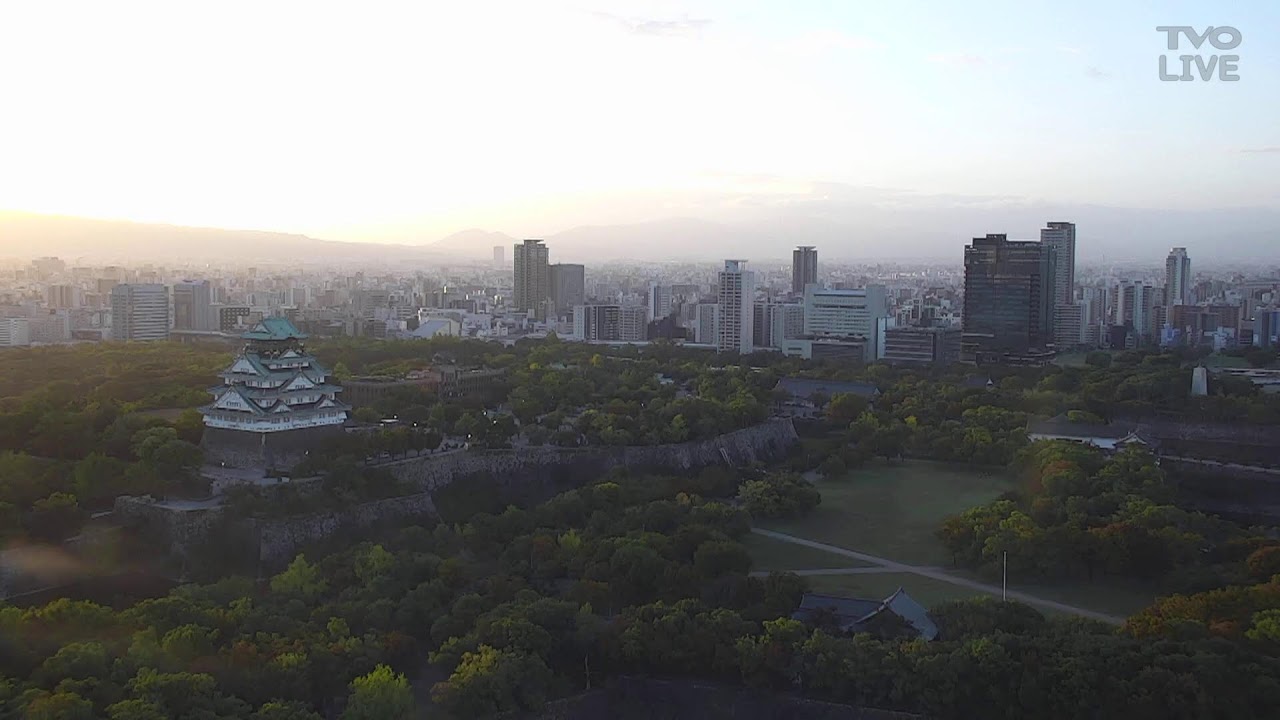
Faces: Across the park, with the castle keep on the left and the towers of central Osaka behind
What you’ll see: The park’s trees from above: in spring, drifts of pale blossom around the moats and lawns below the keep. It is a wide weather view, so expect the blossoms as a haze of colour rather than close-up flowers.
When: Daylight in Osaka. Osaka’s typical full bloom is early April. Typical dates for Osaka.
Summit deck of the Mt. Fuji Panoramic Ropeway, above Lake Kawaguchi
Live videoFujiyamaNAVI
Faces: Mount Fuji, from the Kawaguchiko side
What you’ll see: The mountain itself, still snow-capped in spring. The blossoms around Lake Kawaguchi typically come later than the mainland cities, so this is the camera to watch in mid-spring rather than late March.
Faces: The thatched-roof station and the line through the valley
What you’ll see: The town streams it for the seasons: cherry blossoms around the station in spring, trains passing, autumn leaves and deep snow in winter.
When: Daylight in Japan. In the mountains of Aizu, blossom typically comes in April, later than Tokyo. Typical dates for Aizu.
The National Park Service calls peak bloom on the day 70% of the Yoshino cherry blossoms are open, and says it is most likely between the last week of March and the first week of April. Unusually warm or cold weather has moved it as early as March 15 (1990) and as late as April 18 (1958). In 2026 the Park Service announced its forecast (March 29 – April 1) on March 5, and peak bloom came on March 26, a few days ahead of it. The NPS itself warns that forecasting peak bloom is almost impossible more than 10 days in advance.
The 2027 National Cherry Blossom Festival runs from March 20 to April 11, 2027. The festival is fixed months in advance; the trees are not, so peak bloom can come early in it, late in it, or just outside it.
For the trees themselves, the Trust for the National Mall’s #BloomCam looks over the Tidal Basin. It plays in its own EarthCam player on that site, so we link to it rather than embed it here.
Faces: West down the National Mall to the Lincoln Memorial and the Potomac
What you’ll see: The Mall from the highest point in the city: the World War II Memorial, the Reflecting Pool and the Lincoln Memorial. The Tidal Basin is just south of the monument; for the trees themselves, the Trust for the National Mall’s #BloomCam (linked below) looks straight at them.
When: Daylight in Washington (Eastern Time). Peak bloom is most likely between the last week of March and the first week of April.
Japan. The Japan Meteorological Agency records the blossoms; the forecasts come from private forecasters. The Japan Meteorological Corporation and Weathernews publish their first forecasts for the coming spring from around December or January (the Corporation’s first for 2026 came out in mid-December 2025) and update them through the spring until the trees open. The Japan National Tourism Organization collects them in English.When the season starts, JMA announces each station’s first and full bloom as its staff see them on the sample trees, and posts them in the same tables we quote.
Washington, DC. The National Park Service announces its peak-bloom forecast as spring approaches (on March 5 in 2026) and follows the buds through five stages on its Bloom Watch page: green bud, florets visible, extension of florets, peduncle elongation and puffy blossoms, then peak bloom.Until then, the long-term window above is the honest answer.
We will not put a 2027 date on this page until one of those sources publishes it. If you see one quoted now, it is a guess.
What you will see on the cameras, and when
January to February: Okinawa’s Taiwan cherries, pink and earlier than anything on the mainland. Our Naha camera is a harbour view, so it shows the weather there rather than the trees.
Late March to early April: the big show. Kyoto and Osaka typically reach full bloom around April 4 and Mount Fuji’s lakes a little later; this is when the Philosopher’s Path and Osaka Castle Park cameras are at their best. Washington’s peak usually falls in the same fortnight.
April: the countryside and the north. Noto-Kashima’s blossom tunnel over the platform and the trees around Yunokami Onsen’s thatched station, and then northern Honshu.
Late April to May: Hokkaido, around Golden Week.
The rest of the year: the same views without the blossom: green summers, autumn leaves on the Philosopher’s Path and around Yunokami, and snow in Aizu. Worth a look, just not for sakura.
JMA declares first bloom when five or six flowers have opened on a station’s sample tree, and full bloom when about 80% of its buds are open. On the cameras, watch in daylight at the camera’s own time, shown next to each one above.
When do the cherry blossoms bloom in Japan in 2027?
Nobody knows the 2027 dates yet, and anyone who gives exact ones this far ahead is guessing. Typically, going by the Japan Meteorological Agency’s 1991–2020 normals, Okinawa’s cherries open in mid-January, Kyushu, Tokyo, Kyoto and Osaka between about March 22 and 27 with full bloom around March 31 to April 4, northern Honshu in mid to late April, and Hokkaido around the start of May. Private forecasters such as the Japan Meteorological Corporation and Weathernews publish their first forecasts for the season from around December or January and update them through the spring.
When is peak bloom in Washington, DC in 2027?
Not forecast yet. The National Park Service defines peak bloom as the day 70% of the Yoshino cherry blossoms around the Tidal Basin are open, and says it is most likely between the last week of March and the first week of April. It has come as early as March 15 (1990) and as late as April 18 (1958). In 2026 the NPS announced its forecast on March 5 and peak bloom was reached on March 26. The NPS notes that forecasting peak bloom is almost impossible more than 10 days ahead.
What are the dates of the 2027 National Cherry Blossom Festival?
March 20 to April 11, 2027, according to the National Cherry Blossom Festival. The festival is set months ahead and the trees bloom when the weather says so, so peak bloom can fall anywhere in or around it.
Is there a live cam of the cherry blossoms at the Tidal Basin?
Yes: the Trust for the National Mall runs #BloomCam, an EarthCam camera looking over the Tidal Basin’s cherry trees, at bloomcam.org. It plays in its own player on that site, so we link to it rather than embed it. On this page, EarthCam’s Washington Monument camera shows the National Mall from the top of the monument, just north of the Tidal Basin.
What is the difference between first bloom and full bloom in Japan?
The Japan Meteorological Agency declares first bloom (kaika) when at least five or six flowers have opened on its sample tree at a station, and full bloom (mankai) when about 80% of the buds on that tree are open. In JMA’s normals full bloom comes about a week after first bloom in the cities of western and central Japan, and four or five days after it in the north, which is why the timeline on this page shows both.
Where are the first and last cherry blossoms in Japan?
The first are in Okinawa and the Amami Islands, where the Taiwan cherry opens in January; JMA’s normal first-bloom date for Naha is January 16. The last are in Hokkaido: Sapporo’s normal first bloom is May 1, and in the far north and east of the island the Ezo mountain cherry opens into mid-May.
Why is there no blossom on the cameras now?
Because it is not the season. Outside January–February in Okinawa and roughly March to mid-May elsewhere in Japan and late March to early April in Washington, the trees are in leaf or bare. The countdown on this page shows how many days remain until each place’s typical full bloom, and the cameras stay worth a look for the views in the meantime.
Camera feeds belong to their operators (the Kyoto City Tourism Association, TV Osaka, Anamizu and Shimogō towns, EarthCam, FujiyamaNAVI for the Mount Fuji camera, and Windy), named on each camera page. Bloom dates: the Japan Meteorological Agency’s 2021–2026 records and 1991–2020 normals; Washington: the National Park Service and the National Cherry Blossom Festival. Day counts are computed in your browser from those typical dates.
THE WORLD IS ALWAYS ON.
A WINDOW TO SOMEWHERE ELSE
Start somewhere:
POCTIX · FOR VENUES & ORGANIZERS
Bring your stage to audiences everywhere.
Sell tickets for the room. Make a plan to stream your next show beyond it.
We use cookies for analytics and ad personalization. Decline keeps the site working;
Accept helps us improve and supports our free streams.
Learn more.