Share your scenic view.
Bring your coastline, harbor or mountain view to Port of Cams.
Explore camera hosting →

Iceland sits close under the auroral oval, so aurora is common from September to April whenever the sky clears. These cameras cover the north, the Golden Circle and Reykjavík, which is useful because Iceland's cloud rarely covers the whole island at once.
The live planetary K-index loads from NOAA in your browser.
Roughly what puts aurora in Reykjavík’s sky on a dark, clear night. Higher Kp brings it overhead and brighter.
Tonight’s verdict compares NOAA’s Kp forecast for Reykjavík’s dark hours with the Kp needed here.
A dark live-video camera with the least cloud; a snapshot camera only when no video camera here is dark. Press play to watch it here.
Ranking the cameras by darkness and cloud…
Live video first, then snapshot cameras (still images that refresh every few minutes, including science all-sky cameras). Within each group: dark now first, then least cloud. “Dark” means the sun is more than 12° below the horizon at that camera; cloud is Open-Meteo’s current model value for the spot.
 Hólar, North Iceland Hólar, Hjaltadalur, North Iceland Live video Dark (sun below −12°) until 7:01 AM GMT
 Golden Circle, South Iceland Golden Circle, South Iceland Live video Dark (sun below −12°): 7:11 PM GMT – 7:06 AM GMT
 Reykjavík sky cam, Iceland Grandi, Reykjavík, Iceland Live video Dark (sun below −12°): 7:16 PM GMT – 7:11 AM GMT
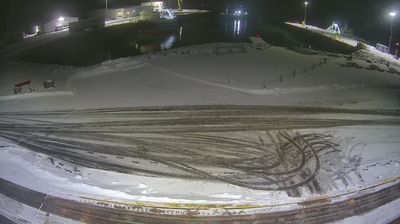 Kirkjufell, Grundarfjörður, Iceland Grundarfjorur, Iceland Snapshot Dark (sun below −12°): 7:21 PM GMT – 7:16 AM GMT
 Skinnastaður, Northeast Iceland Northeast Iceland Snapshot Dark (sun below −12°) until 6:51 AM GMT
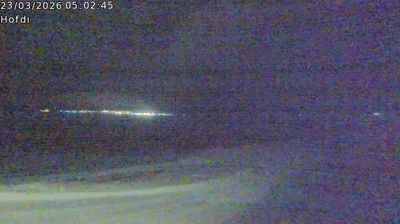 Westfjords, Iceland ingeyri, Iceland Snapshot Dark (sun below −12°): 7:21 PM GMT – 7:21 AM GMT
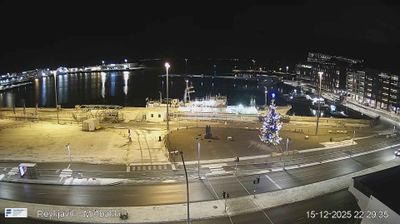 Reykjavík Harbour, Iceland Reykjavik, Iceland Snapshot Dark (sun below −12°): 7:16 PM GMT – 7:11 AM GMT
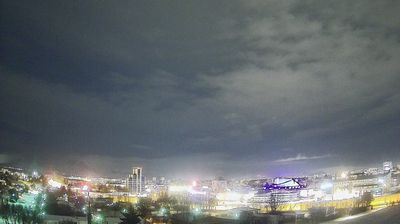 Reykjavík Skyline, Iceland Reykjavík, Iceland Snapshot Dark (sun below −12°): 7:16 PM GMT – 7:11 AM GMT
Iceland is further from the magnetic pole than northern Norway, but its geomagnetic latitude is high for its size, and the oval passes over or just north of it on most nights. As a working rule:
| Where | Usually visible at | Notes |
|---|---|---|
| North Iceland (Akureyri, Mývatn, Húsavík) | Kp 1–2 | Often overhead; often drier than the south-west |
| Westfjords, Snæfellsnes (Kirkjufell) | Kp 2 | Very dark, very changeable weather |
| Golden Circle, South Coast | Kp 2–3 | Dark once you leave the towns |
| Reykjavík city | Kp 3 and up | Light pollution hides faint arcs; Kp 2 is visible from the city edge |
Iceland’s own forecasts are worth knowing. The Icelandic Met Office (vedur.is) publishes an aurora forecast with a cloud-cover map, and the cloud map matters more than the Kp line. Weather fronts usually come in from the south-west, so when Reykjavík is socked in, the north and east are often clear, and the other way round.
Season: roughly late August to mid-April. Iceland is just south of the Arctic Circle, so it does have a short night even in midsummer, but from mid-May to early August the sun never gets 12° below the horizon and the sky is too bright.
Time of night: Iceland keeps UTC all year, which puts its clocks well ahead of the sun. Magnetic midnight there is around 23:30–00:30, and the best stretch is usually 22:00–02:00.
Near Reykjavík: Grótta lighthouse at the tip of Seltjarnarnes, the shore at Ægisíða, or a 45-minute drive to Þingvellir National Park. On Snæfellsnes, Kirkjufell above Grundarfjörður is Iceland’s most photographed aurora foreground. On the south coast, Jökulsárlón glacier lagoon and the beaches at Vík. In the north, the lake at Mývatn and the hills above Akureyri. Wherever you go, check road.is for road conditions and safetravel.is before driving at night in winter.
A camera sees more than your eyes do. On a quiet night it may record a pale green band that looks grey or white to a person standing beside it. When the cameras show strong green with structure, rays or movement, it is bright enough to see easily outside.
Kp: NOAA Space Weather Prediction Center. Cloud: Open-Meteo. Camera feeds belong to their operators, named on each camera page.
Sell tickets for the room. Make a plan to stream your next show beyond it.
Try another place or clear your filters.
Bring your coastline, harbor or mountain view to Port of Cams.
Explore camera hosting →Plan cameras, mixer audio and a ticketed livestream. Onsite installation or remote-assisted setup, scoped for your venue.
Plan a concert livestream →